

Are your back pain, burning urination, or blood in the urine actually early signs of kidney stones? In most cases, yes, and you’re not alone. Kidney stones affect roughly 1 in 11 people in india at some point in their lives.
Kidney stone symptoms usually show up as sharp pain in the side or back, pain that shifts toward the lower abdomen or groin, burning urination, frequent urges to pee, blood in the urine, cloudy urine, nausea, vomiting, fever, or chills. The good news is that symptoms are mostly the same in men and women. The difference is where the pain travels. Men often feel it move toward the groin or testicles. Women sometimes mistake it for a UTI or period cramps. Knowing the difference matters, and that’s exactly what this guide walks you through.
Kidney Stones Usually Cause Symptoms When They Move or Block Urine Flow
Here’s the part that surprises most people: a kidney stone can stay quietly for months without causing a single symptom. The trouble starts the moment it moves. Once that happens, pain can appear out of nowhere, and it tends to escalate fast. Before we get into the nine warning signs, it helps to understand what a stone actually is and why it turns painful so suddenly.
- What Is a Kidney Stone?
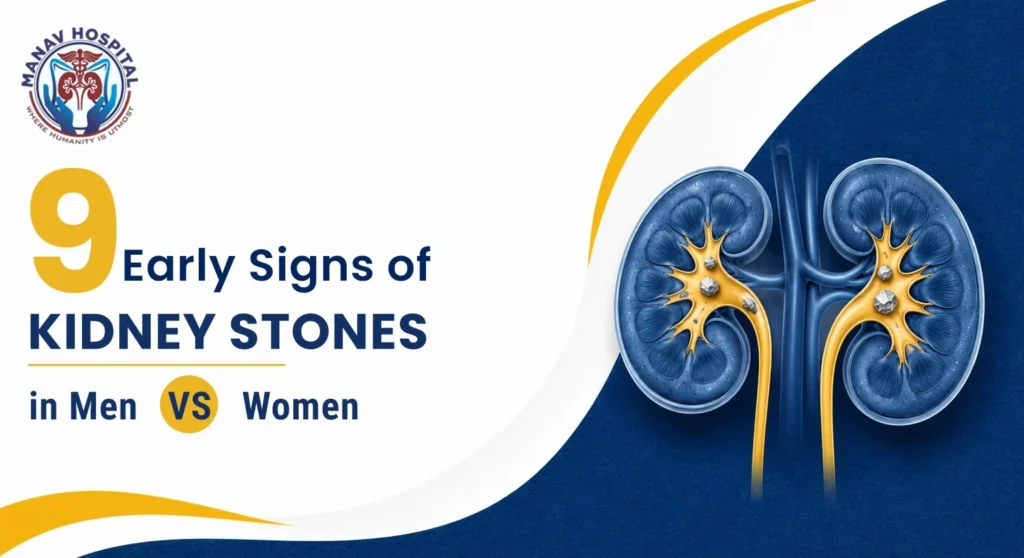
A kidney stone is a hard mineral and salt deposit that forms inside the kidney. Stones range from the size of a grain of sand to something closer to a golf ball. Small ones often pass unnoticed. Larger ones tend to get stuck.
- Why Do Kidney Stone Symptoms Start Suddenly?
Symptoms of kidney stones usually begin when a stone leaves the kidney and enters the ureter, the narrow tube that carries urine to the bladder. A stone lodged there blocks urine flow, and the kidney swells slightly from the backup. That swelling is what triggers pain, often within minutes.
- What Is Renal Colic?
Renal colic is the medical term for the intense, cramping pain caused by a stone moving through the ureter. It comes in waves, builds to a peak, and can leave you unable to sit still. Renal colic is one of the most severe types of pain a person can experience, often compared to labor pain.
The 9 Early Signs Include Pain, Urine Changes, Nausea, Vomiting and Fever
Not every symptom shows up at once. Some people notice just one or two early signs of kidney stones before anything else develops. Here’s what to watch for, listed in the order they most commonly appear.
1. Sharp Pain in the Side, Back or Below the Ribs
This is usually the first sign. The pain stays just below the ribs, on one side, and can range from a dull ache to a stabbing sensation that stops you mid-step.
2. Pain That Moves to the Lower Abdomen or Groin
As the stone travels down the ureter, pain often follows it. What starts in the back can shift toward the lower belly or groin within hours.
3. Burning or Pain While Urinating
Burning urination is a classic kidney stone symptom, especially once the stone nears the bladder. It’s also one of the biggest reasons people confuse kidney stone vs UTI symptoms.
4. Frequent Urge to Urinate
You may feel like you need to go constantly, even right after emptying your bladder. This happens when a stone irritates the lower ureter or bladder wall.
5. Blood in Urine
Blood in the urine, sometimes visible, sometimes only detected on a lab test, is one of the most common kidney stone warning signs. Urine may look pink, red, or cola-colored.
6. Cloudy or Foul-Smelling Urine
Cloudy or strong-smelling urine can point to a stone, an infection, or both. Either way, it’s worth getting checked rather than waiting it out.
7. Nausea or Vomiting with Pain
The kidneys and digestive tract share nerve connections, which is why intense stone pain frequently triggers nausea or vomiting.
8. Fever or Chills
Fever alongside stone symptoms can signal an infection above the blockage, a combination doctors treat as urgent.
9. Difficulty Passing Urine or Reduced Urine Flow
A stone fully blocking the ureter can slow urine output dramatically or stop it altogether. This needs same-day medical attention.
Here are the early signs of kidney stones, what they feel like and when to worry:
| Early Sign | What It Feels Like | When to Worry |
| Side or back pain | Sudden, sharp, one-sided ache | Pain that won’t ease with rest or position change |
| Pain moving to the groin | Cramping that travels downward | Pain paired with nausea or vomiting |
| Burning urination | Stinging sensation while peeing | Burning plus fever or chills |
| Frequent urination | Constant urge, little output | Combined with pelvic pressure |
| Blood in urine | Pink, red, or brown-tinted urine | If you see any visible blood, see a doctor promptly |
| Cloudy urine | Murky, strong-smelling urine | Cloudiness with fever |
| Nausea/vomiting | Queasiness during pain episodes | Unable to keep fluids down |
| Fever or chills | Body temperature above 100.4°F | Fever with flank pain, seek urgent care |
| Reduced urine flow | Weak stream or minimal output | Little to no urine for 6+ hours |
Note: If you’re noticing three or more of these signs together, especially pain plus fever, or pain plus blood in urine, don’t wait for symptoms to “settle down” on their own. Book a same-week consultation.
Men and Women Usually Have Similar Kidney Stone Symptoms, But Pain Location Can Feel Different
Kidney stones don’t discriminate much between men and women when it comes to the underlying symptoms. What changes is how those symptoms get interpreted, largely because of anatomy and overlapping conditions that mimic stone pain.
Kidney Stone Symptoms More Commonly Noticed by Men
Men often report pain traveling toward the groin or testicles, alongside burning urination, blood in the urine, and frequent urination. Testicular discomfort, in particular, sometimes leads men to mistake it for an unrelated issue.
Kidney Stone Symptoms Women May Confuse with UTI or Period Pain
Women frequently describe pelvic or lower abdominal discomfort that feels a lot like period cramps or a bladder infection. Burning urination, frequent urination, back pain, and fever can all overlap with a UTI, which is why lab testing matters before assuming either diagnosis.
Kidney stone symptoms in men vs women:
| Symptom | More Common Presentation in Men | More Common Presentation in Women |
| Pain radiation | Groin, testicles | Lower abdomen, pelvis |
| Urinary burning | Frequently reported | Frequently reported, often mistaken for UTI |
| Blood in urine | Common | Common |
| Cramping pattern | Sharp, wave-like | Sometimes confused with menstrual cramps |
| Fever with pain | Signals possible infection | Signals possible infection |
Men are diagnosed with kidney stones roughly twice as often as women, though the gap has been narrowing over the past two decades, largely tied to diet and lifestyle shifts.
Kidney Stone Pain Usually Starts in the Side or Back and Can Move to the Groin
Kidney stone pain location is one of the biggest clues in figuring out if what you’re feeling is a stone. It has a fairly predictable path, even though the intensity varies from person to person.
- Why Does Kidney Stone Pain Come in Waves?
The ureter contracts and relaxes as it tries to push the stone along, which is why pain rises, peaks, briefly eases, then returns. This wave pattern is a hallmark of renal colic.
- Right-Side vs Left-Side Kidney Stone Pain
Pain shows up on whichever side the stone is located; it doesn’t switch sides. Right-sided pain sometimes gets mistaken for appendicitis, while left-sided pain can be confused with other abdominal issues, which is exactly why imaging matters.
- When Pain Location Suggests Urgent Care
If pain moves into the lower abdomen accompanied by fever, vomiting, or an inability to urinate, that combination points to urgent care rather than a wait-and-see approach.
Kidney Stones Can Look Like UTI, Period Pain, Back Pain or Gas Pain
This is where a lot of self-diagnosis goes wrong. Several common conditions share overlapping symptoms with kidney stones, and telling them apart at home is genuinely difficult.
- Kidney Stone vs UTI
Both cause burning urination and frequent urges to go. UTIs rarely cause the sharp, wave-like flank pain typical of stones, and stones don’t always come with the constant urinary discomfort seen in infections.
- Kidney Stone vs Period Pain
Period cramps are usually centered low in the pelvis and follow a predictable monthly pattern. Kidney stone pain is one-sided, often starts in the back, and doesn’t follow a cycle.
- Kidney Stone vs Back Pain
Muscular back pain typically worsens with movement and eases with rest. Kidney stone pain does the opposite; it can strike even while lying still and doesn’t improve with position changes.
- Kidney Stone vs Gas Pain
Gas pain tends to shift around the abdomen and often resolves within hours. Kidney stone pain stays localized to one side and tends to intensify rather than pass.
Kidney Stone vs UTI vs Period Pain vs Back Pain vs Gas Pain:
| Condition | Pain Pattern | Urinary Symptoms | Resolves With Rest? |
| Kidney stone | One-sided, wave-like, radiates to the groin | Burning, blood, frequency | No |
| UTI | Lower pelvic pressure, mild ache | Burning, frequency, urgency | Partially, with antibiotics |
| Period pain | Cyclical, centered low | None | Yes, with a cycle |
| Back pain (muscular) | Worsens with movement | None | Yes, with rest |
| Gas pain | Shifting, cramp-like | None | Yes, within hours |
Fever, Vomiting, Blood in Urine or Urine Blockage Can Be Emergency Signs
Most kidney stones are painful but not dangerous. Some symptom combinations, though, need same-day medical attention, not a “let’s see how tomorrow goes” approach.
When Should You See a Doctor?
See a doctor if pain is severe, urine looks bloody, or symptoms last more than a day or two without improving.
When Should You Go to Emergency Care?
Go to emergency care if you have a fever above 100.4°F, persistent vomiting, or can’t urinate at all. These signs may point to an infected, obstructed kidney, a situation that needs immediate treatment. Here’s when to see a doctor for kidney stone symptoms:
- Severe, unrelenting pain
- Fever or chills
- Persistent vomiting
- Visible blood in urine
- Unable to urinate
- Pregnant with severe urinary pain
- Known single kidney or existing kidney disease
If you’ve checked even one box above, treat it as urgent rather than something to monitor overnight.
Kidney Stones Are Diagnosed With Urine Tests, Ultrasound and CT Scan
You can’t diagnose a stone just by matching kidney stone emergency symptoms to a list. Doctors need actual tests, and they usually start simple before moving to imaging.
- Urine Test
This is often the very first thing a doctor orders. It checks for blood, infection markers, and tiny crystals that hint at stone activity.
- Blood Test
A blood test tells your doctor how well your kidneys are functioning and whether your calcium levels are normal, both useful clues.
- Ultrasound KUB
No radiation involved here. It’s a solid first imaging option, and it’s usually the go-to choice if you’re pregnant.
- CT Scan KUB
Want the clearest picture possible? This is it. A CT scan pinpoints the stone’s exact size and location, which is why doctors prefer it when ultrasound results aren’t conclusive enough.
- Stone Analysis
If you actually pass a stone, or a doctor removes one, sending it for lab analysis can be helpful. It shows what the stone is made of, which then shapes how you prevent the next one.
Kidney Stone Diagnostic Tests:
| Test | Why It’s Used | What It Can Show |
| Urine test | First-line check for infection or blood | Early clues of stone activity |
| Blood test | Checks how the kidneys are functioning | Calcium and creatinine levels |
| Ultrasound KUB | Radiation-free imaging | Stone location, kidney swelling |
| CT scan KUB | Most detailed imaging option | Exact size and position of the stone |
| Stone analysis | Identifies what the stone is made of | Guidance for preventing future stones |
Kidney Stones Are Common in India Because Heat, Dehydration and Diet Can Increase Risk
If you live somewhere hot like Rajasthan, you’re already at a disadvantage when it comes to kidney stones, and it’s mostly down to heat, water habits, and food choices.
Low Water Intake and Dehydration
Sweating more means your urine gets more concentrated, and concentrated urine is exactly where mineral crystals like to form. People who don’t drink enough water throughout the day, especially during summer months, tend to see stones come back again and again.
High Salt or High-Oxalate Diet
Love your pickles? Salty, processed food pushes your risk up. So do oxalate-heavy vegetables like spinach, when eaten in large amounts regularly.
Family History and Recurrent Stones
Got a parent or sibling who’s had kidney stones? Your own odds go up, too. It helps to understand how kidney stones are formed in the first place; that way, you can catch risk factors before symptoms even start.
Treatment Depends on Stone Size, Location, Pain and Infection
Here’s something people often assume incorrectly: not every kidney stone needs surgery. What you actually need depends on the stone’s size and whether infection has set in.
Small Stones That May Pass Naturally
If your stone is smaller than 4mm, there’s a good chance it’ll pass on its own. Just drink plenty of water and give it time.
Medicines and Pain Management
Pain relief helps you get through it, and certain medications relax the ureter so the stone moves along a bit easier.
ESWL, URSL, RIRS and PCNL
Bigger stones may need shockwave therapy or a minimally invasive procedure. Curious what that actually involves? Here’s a full breakdown of kidney stone removal options available at Manav Hospitals.
When a Urologist May Recommend a Procedure
If a stone’s too large to pass on its own, is blocking urine flow, or has triggered an infection, that’s usually when a urologist steps in with a procedure.
Why Choose Manav Hospitals for Kidney Stone Diagnosis and Treatment?
Searching for kidney stone treatment in Jaipur? At Manav Hospitals, you receive experienced urology care alongside modern diagnostic tools; ultrasound and CT imaging are both available on-site, so there’s no running around between labs. The team’s focus stays on finding the right path for you specifically, whether that means simply keeping an eye on a small stone or planning out a procedure for a bigger one.
And if your symptoms are severe or keep coming back, getting checked sooner rather than later really can prevent bigger complications later. The hospital offers patient-focused guidance from your first consultation right through recovery.
FAQs
What are the first signs of kidney stones?
Usually sharp pain in your side or back, often paired with burning urination.
What are the 9 early signs of kidney stones?
Side or back pain, pain that shifts to the groin, burning urination, needing to pee often, blood in urine, cloudy urine, nausea, vomiting, and fever or chills.
Are kidney stone symptoms different in men and women?
Not really at the core, but where the pain travels, and what it gets confused with, can differ.
What are the symptoms of kidney stones in men?
Pain that moves toward the groin or testicles, burning urination, and blood in the urine.
What are the symptoms of kidney stones in women?
Pelvic discomfort, burning urination, and back pain are symptoms that often get mistaken for a UTI or period cramps.
Where is kidney stone pain felt?
It typically starts in your side or back, then moves toward your lower abdomen or groin as the stone travels.