

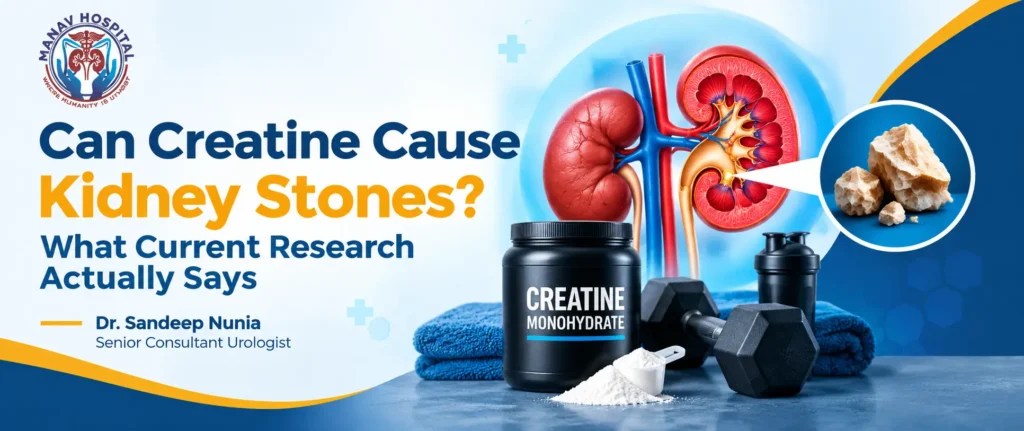
If you know someone suffering from kidney issues, the most important question now is: can creatine cause kidney stones? Current research has not established a direct causal link in healthy adults, but direct evidence for people who have already had a stone is limited.
Most studies measure kidney function rather than stone formation, so they cannot fully settle the question for recurrent stone formers. It also helps to know that creatine can raise serum creatinine on a blood test, and that rise does not automatically mean kidney damage.
So does creatine cause kidney stones, or is the worry mostly a misunderstanding? This guide covers what the latest research says, who should be more careful and when it is worth speaking to a urologist.
Can Creatine Cause Kidney Stones? The Short Answer
No, current evidence has not shown that creatine directly causes kidney stones in healthy adults. A lack of proven harm is not the same as proven safety for every stone former, and that gap leads to uncertainty.
But does creatine cause kidney stones if you have already had one? The answer depends on the person. The CARI nutrition guideline for kidney stone prevention says the safety of creatine and protein supplements cannot be assured in people with kidney stones, because they have not been adequately studied in that group. In other words, the research on creatine kidney stones is thin rather than alarming.
| Who you are | What the evidence suggests | Practical position |
| Healthy adult | No direct link established | Low concern, with sensible hydration |
| Previous kidney stone | Direct evidence very limited | Discuss with a clinician first |
| Recurrent stone former | Direct evidence very limited | Needs an individual assessment |
| Existing kidney disease | A separate issue from stones | Clinician-led decision |
What Is Creatine and What Does It Do in the Body?
Creatine is a compound your body makes naturally and also gets from foods such as meat and fish. In muscle, it is stored as phosphocreatine, which helps recycle ATP, the quick energy source behind sprints and heavy lifts. That is why athletes and gym-goers turn to creatine supplementation to support strength and power.
The most widely studied form is creatine monohydrate, which is also the form used in most trials. One important thing to know is that creatine is not creatinine. The latter is a waste product your kidneys clear and your doctor measures.
Why Do People Think Creatine Causes Kidney Problems?
Mostly because of a name mix-up and a blood test. Creatine and creatinine sound almost identical, and creatinine is the number doctors use to judge kidney health.
Creatine vs Creatinine: They Are Not the Same Thing
They are different substances with different jobs. The table below sets them side by side.
| Creatine | Creatinine |
| A compound and popular supplement used in muscle energy metabolism | A breakdown product measured in blood and used to assess kidney function |
Why Can Creatine Raise Blood Creatinine?
Does creatine increase creatinine? It can, and usually only by a small amount. That happens because your body converts a small share of muscle creatine into creatinine every day.
This is why a lab report showing creatine high creatinine results can look alarming at first glance. The rise, and the creatinine-based eGFR calculated from it, can shift without any structural kidney damage.
What Does the Latest Research Say About Creatine and Kidney Stones?
Kidney-function studies are reassuring for healthy adults, but they are not stone studies. Most trials on creatine kidney function track blood markers, not whether stones form.
| Evidence | Population | Main finding | Important limitation |
| Journal of Renal Nutrition meta-analysis (2026) | Adults in randomised trials | Serum creatinine rose by about 0.13 mg/dL, with no significant change in urea or eGFR | Trials longer than one year are still needed |
| International Urology and Nephrology meta-analysis (2026, 26 trials) | Healthy adults and people with chronic kidney disease | Creatinine-based eGFR fell, but a more direct filtration measure (Cr-EDTA) showed no change, pointing to altered creatinine handling rather than injury | Results varied widely between trials, and it measures kidney function, not stones |
| Tunisie Médicale case report (2022) | One athlete with a previous 11 mm stone | No new stone on ultrasound after two months of supplementing and 14 months of follow-up | A single person, so it cannot be generalised |
| CARI nutrition guideline (2025) | Adults with kidney stones | Safety of creatine cannot be assured in people with stones | A statement of uncertainty, not evidence of harm |
Taken together, the data suggest a rise in blood creatinine without clear kidney injury. Direct research on creatine and kidney stones, though, rests on one case report and one guideline caution.
Does Creatine Increase the Risk of Calcium Oxalate Kidney Stones?
Current evidence has not established creatine as a direct trigger for calcium oxalate kidney stones. Creatine is not oxalate, and it is not a calcium salt, so it does not supply the building blocks of these stones.
The question of creatine calcium oxalate stones really comes down to what happens in your urine. Stones form when urine is concentrated and when calcium and oxalate run high while protective citrate runs low, alongside other metabolic factors.
Can Dehydration, Exercise and Creatine Together Increase Kidney Stone Risk?
Creatine itself has not been proven to cause dehydration, but hard training, heat and too little fluid can concentrate urine. The real concern behind creatine dehydration kidney stones is low urine volume, not the supplement. In hot places like Jaipur, sweat losses add up, and CARI’s fluid and recurrence prevention advice stresses adjusting fluids for exercise and heat.
Can You Take Creatine If You Have Had Kidney Stones Before?
Direct evidence in people with previous or recurrent stones is limited, so there is no universal yes or no. The decision depends on your stone history, how often stones return, your kidney function, stone composition and other risk factors. A urologist who knows your history can weigh these together before you start.
If You Have Had One Kidney Stone
A single stone does not automatically rule creatine out, but it deserves a conversation. Points worth checking with your clinician include:
- Stone type, if it was analysed
- Any known cause for the stone
- Your current kidney function
- Other supplements you take
- How much you train in hot conditions
If You Have Recurrent Kidney Stones
Many ask: Can I take creatine if I have kidney stones that keep coming back? Repeated stones suggest something is driving them. Stone analysis and, in selected cases, a metabolic evaluation with a 24-hour urine collection can identify those drivers before any new supplement is added.
Calcium Oxalate Stone History
Advice for creatine with history of kidney stones of this type depends on your urinary and dietary risk factors, not the supplement’s name alone. Urine volume, calcium intake, sodium and oxalate load all play a part. A stone clinic can look at these and tailor guidance to you.
Uric Acid Stone History
Uric acid stones form through a different mechanism, mainly in persistently acidic urine, so they should not be grouped with calcium oxalate stones. Knowing your stone type lets your clinician judge urine acidity, diet and uric acid levels properly.
Chronic Kidney Disease vs Kidney Stones
Kidney disease and kidney stones are different clinical issues. Someone with reduced kidney function faces extra questions, including how creatinine-based tests are read, so supplement decisions should involve their kidney team.
Should You Get Kidney Tests Before Taking Creatine?
Most healthy people do not need extensive testing. Clinician-directed assessment becomes more relevant in certain situations.
A clinician may want to review creatine kidney function if any of these apply:
- Recurrent kidney stones
- Known kidney disease
- A solitary kidney
- Abnormal previous kidney tests
- Blood in the urine
- Current urinary symptoms
- Complex medication or supplement use
Possible tests include serum creatinine with eGFR, urinalysis, stone analysis, a 24-hour urine collection in selected recurrent stone formers and imaging when clinically indicated. Because a creatine eGFR result can be lower than your true filtration, always mention the supplement to whoever interprets your results.
What If Your Creatinine Level Goes Up After Starting Creatine?
Does creatine increase creatinine? Yes, a modest rise in serum creatinine can occur after you start, and it does not by itself prove kidney injury. If you see a creatine high creatinine blood test result, avoid diagnosing yourself from one value. Tell the clinician interpreting your kidney-function tests that you take creatine, so they can read the number in context.
Is Creatine Safe With a High-Protein Diet or Whey Protein?
Creatine, whey and a high-protein diet are three different exposures, so they should not be lumped together. Questions about creatine whey protein kidney stones are common because many people take them side by side.
Whey isolates and creatine have not been adequately studied in people with kidney stones, so their safety cannot be assured in that group. Separately, it links high intake of non-dairy animal protein with higher stone risk, while dairy protein is associated with lower risk. The risk of high protein diet kidney stones is assessed on the basis of different factors, including protein source, sodium, hydration, stone chemistry and any other supplements.
How Can Creatine Users Reduce Their Overall Kidney Stone Risk?
No supplement routine is guaranteed safe, but general habits lower risk for almost everyone. These are the most common tips for kidney stone prevention for most people:
- Drink enough to avoid chronically concentrated urine, adjusting for heat and exercise.
- Keep sodium moderate, since high intake can raise urinary calcium.
- Avoid cutting calcium unnecessarily, as low calcium diets can raise oxalate absorption.
- Follow a kidney stone diet based on your specific type of stone.
- Avoid stacking several supplements without a clear reason.
- Tell your clinicians about every supplement you take.
Creatine and Kidney Stones: Myths vs Facts
Most common claims are either myths or not established. The table gives quick answers to the ones we hear most.
| Claim | Verdict | Why |
| Creatine and creatinine are the same | Myth | One is a compound, the other a waste product |
| Creatine is proven to cause kidney stones | Not established | No direct causal evidence |
| Creatine is proven safe for every recurrent stone former | Not established | Direct evidence is limited |
| High creatinine always means kidney damage | False | Supplements can raise it without injury |
| Low urine volume can increase stone risk | True | Concentrated urine favours crystal formation |
| All stones have the same cause | False | Stone type and mechanism vary |
What Kidney Stone Symptoms Should Creatine Users Not Ignore?
Any of the symptoms below deserves prompt attention, and none of them proves that creatine caused the problem. Common kidney stone symptoms include:
- Severe pain in the flank or side
- Pain that radiates to the groin
- Visible blood in the urine
- Burning while passing urine
- Nausea or vomiting
- Fever or chills
- Difficulty passing urine
Fever with pain, or being unable to pass urine, are kidney stone warning signs that need urgent medical care. Our guide to the early signs of kidney stones in men and women explains the pattern in more detail. For urine changes specifically, read about blood in urine due to kidney stones.
When Should You See a Urologist Before Taking Creatine?
See a urologist first if you notice the following:
- Repeated kidney stones
- A current known stone
- Previous stone surgery
- A solitary kidney
- Kidney disease
- Persistently abnormal kidney tests
- Visible blood in the urine
- Severe urinary symptoms, or signs of obstruction or infection
If you are in Rajasthan and want an assessment, the team at a urology hospital in Jaipur can review your history and advise.
What We Know vs What We Still Do Not Know
| What we know | What we still do not know |
| Creatine can raise serum creatinine | Long-term recurrence data in recurrent stone formers |
| Measured kidney function in healthy adults has not shown consistent deterioration | Stone-type-specific effects of creatine |
| Low urine volume increases stone risk | Whether creatine matters for people with a stone history |
Science has not shown creatine to be a cause of stones, and it has not cleared it for every stone former either. Until better data arrive, personal advice from your clinician is more useful than any blanket rule.
FAQs
Does creatine cause kidney stones?
Current research has not established that it does in healthy adults. Direct evidence in people with previous stones is limited, so check with a doctor first if you have a stone history.
Can creatine cause calcium oxalate stones?
Creatine is not oxalate, and no direct trigger has been established. Stone risk depends on urine volume, calcium, oxalate and citrate, so hydration and diet matter more than the supplement itself.
Can I take creatine if I have had kidney stones before?
It depends on your stone type, how often stones recur, your kidney function and other risks. Safety cannot be assured for people with kidney stones, so speak to your urologist first.
Does creatine damage kidneys?
Recent research has found a modest rise in serum creatinine but no clear sign of kidney injury in healthy adults. Longer-term studies are still needed.
Does creatine increase creatinine levels?
Yes, modestly. Your body converts some creatine into creatinine, so blood results can read higher without any kidney damage.
Does high creatinine after taking creatine mean kidney damage?
Not by itself. Tell your doctor about the supplement so they can interpret the result, repeat it or use another test.
Does creatine cause dehydration?
It has not been proven to. Training in heat without replacing fluids is the more usual reason for concentrated urine.
Can creatine make an existing kidney stone worse?
There is no direct evidence either way. If you currently have a known stone or symptoms, it is sensible to get it assessed before starting.
Can I take creatine after kidney stone surgery?
Direct evidence is limited, and what exists cannot guide everyone. Recovery, stone type and kidney function all matter, so ask your surgeon before starting.
Is creatine safe with whey protein?
They are different exposures, and neither has been adequately studied in people with kidney stones. For most people, overall diet, sodium and hydration matter more.